Friday, 20 December 2013

Fish Curry Didi Style


Where ever you go in India, if fish is available easily, then there would a recipe for a fish curry. Each recipe would be slightly different in different areas. My sister has lived in Kolkata but still makes fish curry which would perhaps be more in tune with one prepared in the Old Delhi style. This version of Fish Curry is her style. It is lightly different from the one I have written about in the past but I quite liked it.

In Delhi, one mainly gets river fishes. The common fresh water fishes that are generally available in Delhi are Singhara, Surmai, Sole, Rahu and Betki. The first three are easier to fillet as there is only a single central bone, whereas, Rahu and Betki have many small bones. People who don't mind bones may well find the later fishes tastier. 

In preparing this we bought Surmai, which was filleted and cut into 2-3 inches wide pieces. 

Ingredients:

  • 1 Kg Fish cut into small 2-3 inch pieces
  • 4 Small onions chopped or grated.
  • ½ tsf Fenugreek (Methi) seeds
  • 2 tsf Chilli Powder
  • 3 tsf Coriander powder
  • ½ tsf Turmeric (Haldi) powder
  • 1 tsf Salt to taste
  • 2 tsf Mango (Amchoor) powder
  • 3-4 tbsf Oil for cooking

Method:

  1. Heat the oil in a wok. When hot put the Fenugreek seeds.
  2. As soon as the fenugreek seeds turn brown (not black) add onions, chilli powder, coriander powder, salt and Turmeric powder. Brown these over medium heat.
  3. Add Mango powder and mix well.
  4. Add the pieces of fish and lightly fry in the masala.
  5. Add 300 mls of water and mix well. Let the fish cook on open wok so the gravy becomes slightly thick as well. However, this preparation requires thin gravy.

Monday, 16 December 2013

Besan Chilla (Spicy Gram Flour Pancake)


I have been in Delhi for a few weeks now and have tasted so many preparations, which were just memories from childhood, not-so-long-ago! In my journey of exploring new and old dishes during my stay in India, I have picked chilla as my first entry. What better dish than chilla - which is like a pancake, both salty and spicy and is eaten for breakfast!
Chillas can be made from moong dal or besan (gram flour). I would imagine that Chilla - like many-a-besan (gram flour) dishes, originates from Rajasthan. However, Moong dal chillas are more popular amongst families in general, as well as on cookery programmes, whereas I can only remember eating besan chillas for weekend breakfast in our house. I don't remember having chillas at anyone else’s homes either…but this may well be, because it is mainly eaten for breakfast and one doesn’t often get invited for breakfast!
Chillas need to be prepared fresh and eaten straight from the pan. It is usually eaten with chutney and I would specifically recommend eating it with green spicy coriander chutney.
  
Ingredients:
  • 250 gms Besan
  • 1 tsf Ajwain (Carrom seeds)
  • 1 ½ tsf Salt
  • ½ tsf Chilli powder
  • ¼ tsf Turmeric powder
  • 1 tsf Garlic paste
  • 1 tsf Ginger paste
  • Hand full of chopped methi (Kasori)
  • 1 medium onion chopped finely
  • Oil for shallow frying
  • Batter Mix
    Ingredients mix

Method:

  1. Mix all the ingredients except oil with approx 200 mls of water into a batter which should similar consistency to pan cakes batter. Keep aside.
  2. Heat a flat frying pan over medium heat. When hot spread some oil and wipe it with a tissue.
  3. Now put a ladle full of batter in the middle the frying pan and spread it into a pancake.
  4. Put some oil on the pan cake and let it cook it on lower heat till the under surface of the pancake is lightly brown.
  5. Now turn over and cook the other surface till that is also lightly brown. You may want to press the pancake with a flat ladle so the whole pancake is heated evenly.
  6. Eat it with chutney.

Thursday, 21 November 2013

The Journey - Exploring the streets of India for that taste of India

I have such beautiful memories of having the most wonderful food in what we refer to as Purani (Old) Delhi. Delhi is well known for its Bazaars, full of street vendors and small restaurants, famous for a ‘one-dish’ speciality. Some of these vendors became so popular that people would come from far off places and insist on eating at these joints. It is not only Delhi which has such famous and popular food dishes, but there are other towns and cities in India which are equally renowned for their cuisine. These are often referred to as Street food. Sometimes one can even get that perfect Tarka Dal or Mutton curry on the road side at one of the communal tandoors on the main road near villages often catering not only for the villagers but for the passerby's!  

For a long time now I have been thinking of revisiting the streets of India for just that exquisite Indian food. This would be a big undertaking, but something if I can achieve it, would be dream come true.

When we were young we didn't travel much, so I know mainly the streets food vendors of Delhi and some of the cities in Uttar Pradesh. However, we know that every region in India has some classics loved world over. This in mind I have undertaken that I spend longer time in India. I am not sure how I would cover this vast nation of ours, but I do intend to give it a good go. I would have liked to cover one region at a time but, with meagre resources I may just cover different areas opportunistically.

In undertaking this task, I recognise that I would need much help from friends and family. I would also need friendly vendors who would share their stories and occasionally the recipes. When I can’t get the recipes I would like to tell a story which may explain why I think a particular dish deserves to be on my blog. I would also get some local ladies and maids to replicate some of the fabulous dishes which are sold in their villages or towns.

I would love to hear from the hundreds of followers of this blog about their memories from childhood or present. They may have eaten something memorable near to their home or while visiting a place on holiday. I would try my best to visit such places if I can.

In my pre-retired life I was neither a cook nor a blogger. At best I enjoyed a good meal and and a lot of entertaining. I could cook a handful of preparations. However, since I took up cooking I have learnt and am enjoying preparing new and wonderful dishes, which is perfect for entertaining.

Unlike some big and not so big names who come on the TV programs I have undertaken this task independently. This poses great many hurdles. Some like camera handling I have to sort out at the outset and hope with experience I would get better. My friends on the blog have already advised me on the choice of camera, which I have invested in. Now I have to ask someone to help me use these modern cameras to their fullest potential. I am sure there would be many hurdles which I would only come across as I start my journey. 
My enthusiastic friends and family members site professionally made websites of well know chefs and TV personalities to shape my blog on. What they don’t realise it is that neither am I a great cook, nor do I want to copy anyone’s style. I am just a chap who is exploring Indian Street food at its best, and I am trying to write about the story behind these fabulous places. I am sure all my friends mean well and are being helpful. So keep up with the suggestions, I will listen to all but do as I see fit.

This in mind I have booked myself a working holiday for five months in India. My base would be Delhi but I hope to travel to different parts of India and I would hope to bring some colourful sights and recipes. 


Saturday, 17 August 2013

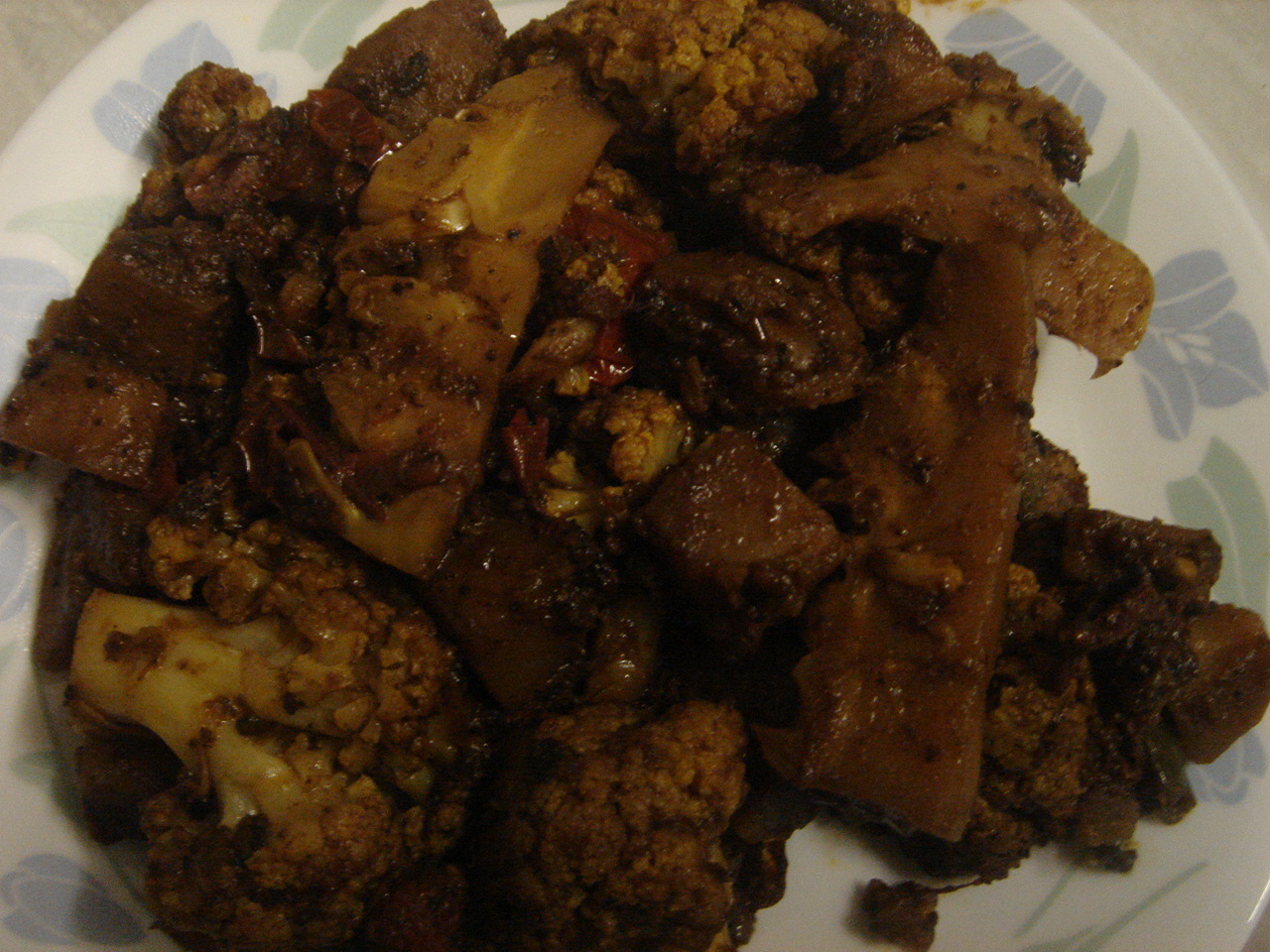
Tamatari Gobi (Cauliflower)


It was a bargain at the Newport Market when I bought a box full of plumb tomatoes. One can eat only so much of it even when the tomatoes are as sweet as the box I bought. I had salad almost everyday, used the fresh tomatoes for cooking and made some tomato chutney. That gave me an idea to try this dish. Along with the box of tomatoes I had also bought fresh ginger and green chillis. I know my friends and family in India must be wondering what is this chap talking about fresh ginger and chillis, well we in the UK(outside London) get very excited when we get fresh Indian vegetables!

I used to love the whole cauliflower that my mother made with green masala as she called it as she didn't use any dry spices for this dish. That recipe is for a later post. This dish is a variation of it. 


Ingredients:

  • One medium sized Gobi (Cauliflower) cut into medium sized pieces
  • 4 tbsf Oil
    Tamatari Gobi
  • 1 small Onion finely chopped
  • ½ tsf Methi seeds (fenugreek seeds)
  • ½ Kg Plumb Tomatoes halved
  • 5-6 Green Chillis chopped
  • 2 inches fresh Ginger cut to matchstick size
  • ½ bunch fresh Coriander chopped  
  • 1 tsf Coriander powder
  • 1 tsf Salt to taste
  • 1 tsf crushed roasted Cumin seeds
  • ½ tsf Garam Masala (optional)


Method:

  1. In a wok heat the oil.
  2. When it is hot add the Methi seeds till they turn dark brown (not black).
  3. Add chopped onions and fry lightly.
  4. Now add the tomatoes, ginger and green chillies, fry till oil separates.
  5. While the tomato masala is browning, put the gobi (cauliflower) pieces in boiling water and leave for 5-10 minutes.
  6. Add salt and coriander powder to the tomato mix and fry for 1-2 minutes.
  7. Now put the gobi (cauliflower) in the tomato mix, pouring the mix over the gobi pieces. Cook in medium heat for the gobi to brown on the edges, before lowering the heat. 
  8. Add the fresh coriander and crushed roasted cumin and garam masala (optional). Cover the wok and let it cook for another10 minutes or till the gobi is done. I like the gobi to be crunchy!

This goes very well with Parathas but also as a side dish with other dishes. 

Thursday, 15 August 2013

Butternut Squash (Kaddu)


Butternut Squash is very similar to the edible Pumpkin (Kaddu) we get in abundance almost all year round in India. I am sure someone will correct me if I am wrong. At least in the UP you would be served almost at every religious festivity. It is cheap and so easy to cook that it is a good vegetable to prepare for larger gatherings in the villages. My favourite  recipe is from my maternal family home. 

Butternut Squash has become very fashionable lately. Lots of chefs on the TV are using it, some in the salads, others mixing it with various meats as a tenderiser or a sweetener. Because of its resurgence it is freely available in the supermarkets of UK. It looks rather grand but tastes exactly like the Kaddu in India. As it is smaller it is very convenient to use up the whole, some as a vegetable and the remainder for salad.

Ingredients:

  • One Butternut Squash cut in to 1 inch chunks. I leave the skin on as it keeps the pieces together and has its own taste. 
  • 3 tbsf Oil
  • 1-2 dried whole red Chilli
  • ½ tsf Methi seeds (fenugreek seeds)
  • ½ tsf Haldi (turmeric)
  • 1 tsf Salt
  • 1 ½ tsf Mango Powder (Amchur)
  • ½ tsf Sugar


Method:

  1. In a wok heat the oil.
  2. When it is hot add the Methi seeds till they turn dark brown (not black).
  3. Crush the whole dried red chilli into 2-3 pieces and add to the oil and let it brown.
  4. Now add the haldi and salt and mix it for 1-2 minutes.
  5. Add the Butternut Squash pieces, mix well with the above ingredients.
  6. Add 2-3 tablespoonful of water cover and cook in low heat for 10 minutes.
  7. Add Mango powder and sugar. Mix well and cover the wok and cook for another 10-15 minutes or till the Butternut Squash can be cut with a blunt spoon. It there is too much fluids remove the cover and let the water evaporate.


Tuesday, 18 June 2013

Sambhar


Sambhar for South Indians is as important as the dal is for the North Indians. It is probably prepared with a whole variety of meals. All sections of South Indian society will not present a meal without the Sambhar. It fact some would say this is the way South Indians prepare their dal. The flavour varies not only depending on the vegetable one adds but also from region to region of South India.

I spent a couple of days with my friends from Kerala, and what a treat that turned out to be. Did we not only make Dosas but I ended up learning how to make authentic Keralite Sambhar, Rasam, Idli and vadas. I think I will start my South Indian section with Sambhar, which as I have mentioned, is so central to the South Indian cuisine that it deserves to be the first item on this blog.

I have included Sambhar for my Kayastha family as a treat, it is slightly different from the dals they prepare. It is full of goodness not only from the dal but the fresh vegetables from our local market.

Ingredients:
  • 3/4 cup Toor or Masoor dal 
  • Chopped vegetables - Couple of carrots, Potatoes, 1 chopped onion, 4 florets of cauliflower, courgette are just a few examples that can be used.
  • 1 tsf Mustard seeds
  • Few Curry leaves
  • 1 tsf Hing (asafetida)
  • 1 Whole Red Chilli
  • 1/2 tin of chopped Tomatoes
  • 3-4 tsf Sambhar powder
  • 3/4 tsf Haldi powder(Turmeric powder)
  • Imli (Tamarind) to taste
  • 1 tsf Salt
  • 2-3 tbsf Vegetable Oil for cooking.

Method:
  1. Cook the dal in a pan. It needs to be slightly under cooked at this stage.
  2. Add salt and the vegetables for approximately 5 minutes or till the vegetables are slightly cooked.
  3. While the dal is cooking heat the oil in a wok and add mustard seeds (and channa dal optional).
  4. As soon as the mustard seeds start to splutter add the sliced onions, dried red chilli, fresh curry leaves and fry till onions are slightly browned.
  5. Add sambhar powder, hing and haldi. Mix and fry for a couple of minutes.
  6. Add the chopped tomatoes and mix stir well browning these slightly.
  7. Add the dal to this mix and cook for another 4-5 mnutes.
  8. Add imli and mix well.
Normally I would make Sambhar with Dosa's or Idli, but here I have prepared it with a vegetarian meal and I surely have enjoyed it.


Monday, 17 June 2013

Methi Gajjar (Carrot)

This is part of the food I prepared for someone who is a vegetarian and doesn't use onion and garlic in their cooking. This dish is similar to the methi aloo to make but tastes different. I picked gajjar as this was what I had bought in abundance from the local market. Lots of my friends have thought that it tastes of prawns (I don't think so!), so for my vegetarian friends this may be as near a taste as you will get of prawns!


Ingredients:
  • ½ Kg Carrots
  • Pinch of Hing (Asafoetida)
  • 1 Dried Red Chilli
  • 1 ¼ tsf Salt
  • ¼ tsf Chilli powder
  • ½ tsf Haldi (Turmeric)
  • 1 Bunch of Fresh Methi (Fenugreek)
  • 3 tbsf Oil
Method:
  1. Pick the leaves off the methi (if you are lazy like me soak the dry methi, approx 1 cup full) and wash off any dust. 
  2. Peel and cut the carrots in to small pieces, perhaps the size of king prawns (if you want to tease people that it is really a prawn dish .
  3. In a wok heat the oil over medium heat.
  4. When the oil is hot put the hing which will start to sizzle straight away.
  5. Break the dried chilli into 2-3 pieces and add it to the oil, wait till the chilli has browned.
  6. Add haldi and chilli powder and cook it for 2-3 minutes.
  7. Add the carrots and slightly fry these may be for 5 minutes.
  8. Add the washed methi leaves, mix well.
  9. Add the salt. Lower the lid and cook till the carrots are soft. You may need to stir a few times ensuring the carrots don’t catch at the bottom.